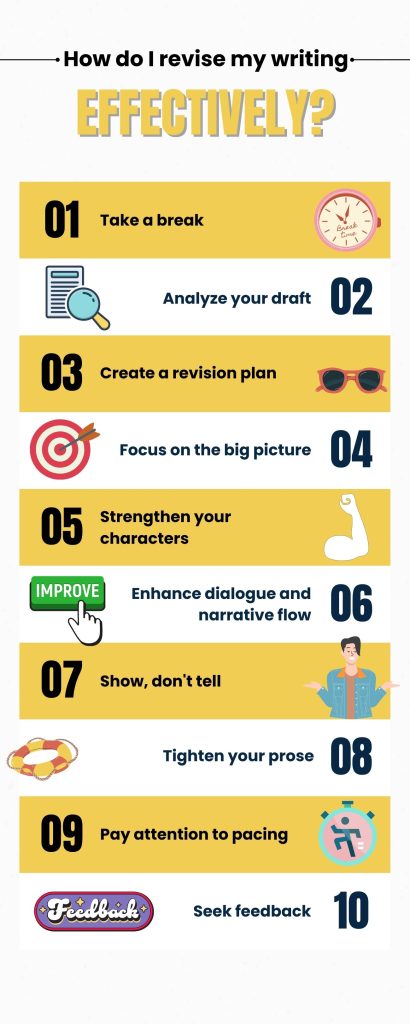
This is a question often asked by writers of fiction. Everyone from short story writers to novelists has to deal with this part of writing; Revision. How does that saying go? “All great writing is rewriting.” Or something like that.
Revising your work is like trying to make a cake from scratch – it’s messy, it’s time-consuming, but boy oh boy, is it worth it! Revision turns pithy and embarrassing first drafts into masterpieces. Or at least it has the potential to.
Here are some tips to help you make that cake, I mean, revise your work:
Take a break
After completing a draft, step away from your writing for a while. Go outside, smell the roses, pet a dog, do whatever it takes to clear your head. This will allow you to approach your work with fresh eyes and a more objective perspective during the revision process.
Analyze your draft
Read your entire manuscript from start to finish, and try not to cringe too hard. Focus on the overall structure, plot, character development, and pacing. Take note of areas that require improvement, inconsistencies, or sections that may need to be reworked.
Create a revision plan
Based on your analysis, create a revision plan that outlines specific areas or chapters you need to address. This plan will keep you organized and focused during the revision process. Think of it like a grocery list, but instead of milk and eggs, you need to fix your plot holes and weak character arcs.
Focus on the big picture
Start by addressing major structural issues, such as plot holes, weak character arcs, or pacing problems. Think of it like building a house – you can’t put up the wallpaper until you’ve got the foundation sorted.
Strengthen your characters
Characters are the heart of any story. Evaluate their motivations, actions, and relationships. Make sure each character has a distinct voice and purpose, and that their actions align with their traits and goals. Think of it like giving your characters a personality transplant.
Enhance dialogue and narrative flow
Dialogue should sound natural and reveal information about the characters and the plot. Streamline narrative passages, eliminate unnecessary details, and ensure a smooth flow between scenes and paragraphs. Think of it like giving your story a spa day – it needs to be smooth and relaxing.
Show, don’t tell
Look for opportunities to show emotions, actions, and settings through vivid descriptions and sensory details, rather than simply telling the reader what is happening. This creates a more immersive reading experience. Think of it like painting a picture, but with words instead of paint.
Tighten your prose
Eliminate wordiness, clichés, and repetitive phrases. Make each word count and strive for clarity and precision. Vary sentence structure and length to maintain reader engagement. Think of it like a game of Jenga – you need to remove the unnecessary blocks without toppling the whole tower.
Pay attention to pacing
Maintain a balance between slower, introspective moments and faster-paced scenes. Consider the overall rhythm of your story and ensure that it keeps the reader engaged throughout. Think of it like a rollercoaster – you need to keep the reader on the edge of their seat, but not make them vomit.
Seek feedback
Share your revised work with trusted beta readers, writing groups, or professional editors. Their fresh perspectives can provide valuable insights and identify areas for further improvement. Think of it like a taste test – you want to make sure your cake is delicious before you serve it to your guests.
In conclusion, revising your work may seem daunting, but with a little bit of humor and a lot of patience, you can create a story that is as sweet as a cake. So go ahead and revise your work – your readers (and your taste buds) will thank you for it!